


A Look Back at “Superman” and “Superman II”
- Matt Palmer
- Jul 6, 2025
- 5 min read

The long-awaited reboot of the “Superman” franchise opens nationwide and at the Dietrich Theater on July 11. Not only is the upcoming “Superman” a reboot of the series, it’s also considered to be a reboot of the DC film franchise in general.
So, with the new movie coming out soon, I wanted to work on a revisit of the “Superman” live action franchise. This review will be for the 1978 classic “Superman” and its 1981 sequel “Superman II” (the theatrical cut).
In the 1978 film, just before the destruction of the planet Krypton, scientist Jor-El sends his infant son Kal-El on a spaceship to Earth. Raised by kindly farmers Jonathan and Martha Kent, young Clark discovers the source of his superhuman powers and moves to Metropolis to fight evil.
As Superman, he battles the villainous Lex Luthor, while, as novice reporter Clark Kent, he attempts to woo co-worker Lois Lane.
“Superman: The Movie” is not only one of the first big budget comic book movies released theatrically, it really showed audiences what studios can do for a large scale production based on a comic book property. Despite its dated special effects, this film is highly enjoyable to watch with its memorable characters, a great story and even some humor.
This 1978 film delivers quite a few memorable sequences that fans of the superhero will enjoy. The first act of this film shows us his origin story, which is one of the better parts of this film. Also, during his origin section of the story, we see his journey to the Fortress of Solitude (which is easily one of the most remarkable sets in a film at that time).
Another aspect that made “Superman” truly memorable is the Lex Luthor part of the film’s plot, which involves Luthor planning to use Kryptonian crystals to form a new continent that he can control. The late Gene Hackman also did a great job portraying the infamous villain, who can be both a little menacing and a little silly/campy.
1978s “Superman” also does a good job having a light-hearted tone and not getting too dark. With its entertaining moments and incredibly iconic score, the film helped popularize the superhero film genre in mainstream cinema and is often cited as a high point in superhero movie history.
In the 1981 sequel, Superman foils the plot of terrorists by hurtling their nuclear device
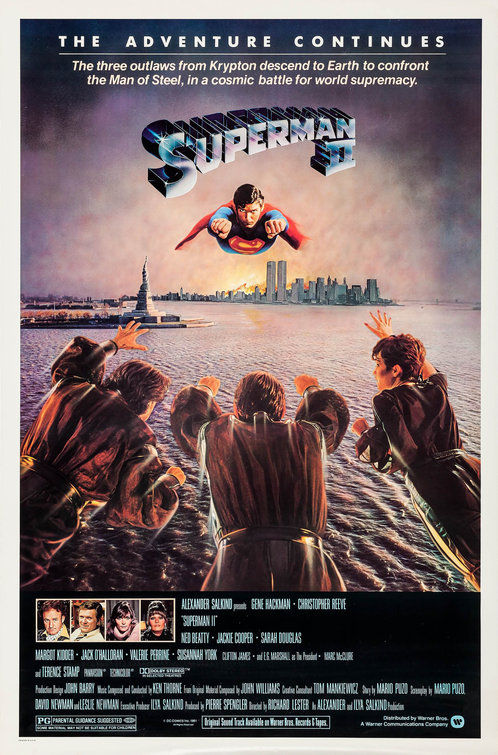
into space, but the bomb’s shock waves free the Kryptonian villain General Zod and his henchman from their imprisonment.
Traveling to Earth, they threaten the planet with destruction at the same time that Superman decides to renounce his superpowers in order to live a normal life as Clark Kent with Lois Lane.
Even though “Superman II” isn’t as impactful as the first film, the 1981 sequel is still a fairly strong sequel. Just like the 1978 film, the sequel does a great job blending the witty moments, the fun exciting action sequences and giving us some memorable villains.
While Lex Luthor is still pivotal to this sequel’s story, this film’s villains (led by General Zod) are very memorable and compelling. Throughout most of their scenes, especially the villain’s attack in Metropolis, it shows how effectively menacing they can be.
Despite its sort of uneven tone and outdated visual effects, “Superman II” is still a solidly entertaining follow up. You can currently stream the entire live action “Superman” franchise” and other DC projects on Max (soon to be HBO Max sometime soon).
To obtain the musculature to convincingly play Superman, Christopher Reeve underwent a bodybuilding regime supervised by David Prowse, the man who played Darth Vader in the original "Star Wars" trilogy.
To maintain on-screen continuity, Christopher Reeve dubbed all of Jeff East's dialogue as young Clark Kent. East's voice is never heard during the film. Though in the TV cut, since the extra footage was never dubbed to begin with, one can hear East's original voice a few times. Occasionally leading to awkward moments where in one scene in certain small moments his voice changes tone because of this.
Much of the footage for what would become Superman II (1980) was written and shot simultaneously with the original. Before shooting was complete for the sequel, however, Richard Donner was fired, and replaced with Richard Lester, who re-shot most of the footage directed by Donner.
Superman creators Jerry Siegel and Joe Shuster were both delighted with the results of this movie.
Christopher Reeve was an unknown actor at the time. The credits and nearly every trailer for this film list Marlon Brando and Gene Hackman before Reeve, who played Superman.
For his portrayal of Clark Kent, Christopher Reeve based the performance on Cary Grant's character in Bringing Up Baby (1938).
In its initial run, the film topped the box-office charts for thirteen consecutive weeks.
The original Superman costume was going to be a much darker blue, but this became transparent with the bluescreen for the visual effects.
In a 2004 interview, Margot Kidder claimed that Richard Donner shot enough scenes to make his own cut of the film, and that the unused footage was "somewhere in a vault." A website started a petition for Warner Bros. to allow and sponsor Donner's cut of this movie. The footage was re-edited into Superman II: The Richard Donner Cut (2006).
Gene Hackman did not return to do reshoots for the second film. All of his scenes were originally filmed by Richard Donner. Other scenes shot by the new director that required Lex Luthor used a look-a-like and a voice impersonator to add any lines needed.
Apparently Richard Lester had to (re-)shoot a large volume of the film to gain a sole director credit, rather than just shoot the remainder of the Richard Donner version scenes to "fill in the gaps." This is why there is a portion of duplicate alternate versions of certain sequences, and scenes in one director's version not appearing in the script of the other version, rather than two alternate edits of one combined source of shot material. Hence why the Donner and Lester cuts are radically different, yet confusingly similar.
Gene Hackman (Lex Luthor), Ned Beatty (Otis), Valerie Perrine (Eve Teschmacher) and E.G. Marshall (The President) were the only actors not to participate in the film's re-shoots under the direction of Richard Lester.
When the sequel was put on hold, Christopher Reeve had commitments to make Somewhere in Time (1980) which overlapped with the return to making Superman II. He also had reservations about the new script and the way Richard Donner had been treated so he was able to renegotiate his contract at a better rate and with more artistic input.


Comments