


A Look Back at the “Jurassic World” trilogy
- Matt Palmer
- Jul 11, 2025
- 5 min read


For the last edition, I took a look at the “Jurassic Park” trilogy, leading up to the new movie, “Jurassic World: Rebirth.” And, for this review, I will be going through the “Jurassic World” trilogy, which did cause a mixed reaction from fans (primarily for its sequels).
In the 2015 movie “Jurassic World,” located off the coast of Costa Rica, the Jurassic World luxury resort provides a habitat for an array of genetically engineered dinosaurs, including the intelligent Indominus Rex. When the massive creature escapes, it sets off a chain reaction that causes the other dinosaurs to run amok.
Now, it’s up to a former military man and animal expert to use his special skills to save two young brothers and the rest of the tourists from an all-out, prehistoric assault.
When I first saw “Jurassic World” when it came out in 2015, I had a blast watching the movie. I remember getting that excited nostalgic feeling since I enjoyed the first trilogy (maybe not the third movie so much). And I still feel the same way with this movie years later.
Throughout this movie, there are quite a few moments that are really thrilling and this movie also had the right amount of fan service to make a nostalgic “Jurassic Park” fan happy. I know it doesn’t live up to the original, and honestly, no other sequel and/or reboot will ever accomplish that.
The scenes that feature the hybrid dino, the Indominus Rex, are incredibly exciting and visually well done. And the climactic battle between the Indominus Rex, the T-rex, one of the raptors and a giant marine dino is one of the best sequences of this trilogy.
In the 2018 sequel “Fallen Kingdom,” three years after the destruction of the theme

park, Owen Grady and Claire Dearing return to the island of Isla Nublar to save the remaining dinos from a volcano that’s about to erupt.
They soon encounter terrifying new breeds of gigantic dinosaurs while uncovering a conspiracy that threatens the entire planet.
Now, while “Fallen Kingdom” has received a mixed reaction from critics and fans, I thoroughly enjoyed it for the most part. The visual effects are really great and this installment does have a darker feel that helps with this sequel.
While “Fallen Kingdom” does have some fairly memorable moments, the first half is truly incredible and intense as the once dormant volcano erupts, wiping the island out. The moment where we see the Brachiosaurus get left behind to face the eruption is still a little moving since its the first dino we see in the original “Jurassic Park.”
The black market concept of this movie where we see dinos get auctioned off to bidders is an interesting concept, yet it kind of felt a little rushed. It did add some effective horror vibes as the dinos do escape and this movie’s dino hybrid causes a lot of havoc.
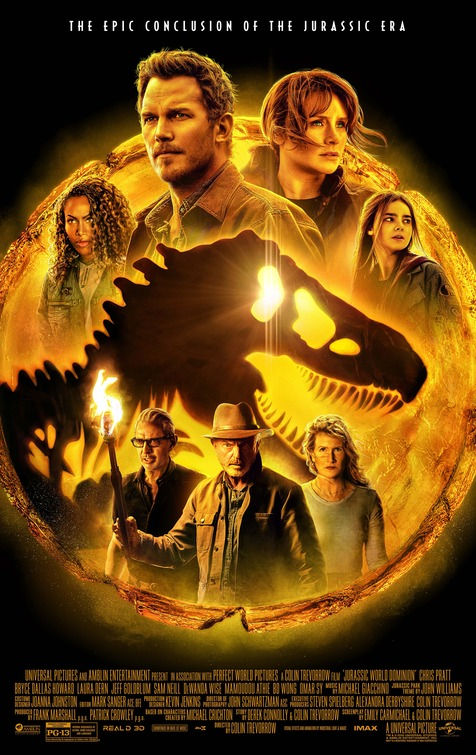
Now, for the 2022 sequel “Dominion.” A few years after the destruction of Isla Nublar, dinos now live and hunt alongside humans all over the world. This fragile balance will reshape the future and determine, once and for all, whether humans are to remain the apex predators on a planet they now share with history’s most fearsome creatures.
This was the first time checking out “Dominion” since I initially reviewed it for the Examiner. After the ending of “Fallen Kingdom,” I was really excited about how this movie would continue the “dinos loose in the real world” premise (which would’ve been really exciting and scary if done right).
The movie does go into the premise, but not as much as they should’ve. “Dominion” mainly focused on the dino sanctuary (which sort of slowed things down a bit) and the movie’s main focus of a genetically modified locust plague would’ve worked better as a small sub-plot and the movie should’ve brought its focus back to the dinosaurs being on the loose. At least for this movie, we were able to see the original “Jurassic Park” characters back together one last time!
You can currently stream the original “Jurassic Park” trilogy on Peacock, while you can stream “Fallen Kingdom” and “Dominion” on Peacock as well. The 2015 “Jurassic World” can be found currently on Tubi.
There is a statue of the character John Hammond, the founder of the InGen Corporation and Jurassic Park. Director Colin Trevorrow explained this is to specifically honor Sir Richard Attenborough, who played the role in Jurassic Park (1993) and The Lost World: Jurassic Park (1997). Attenborough had spoken in the past of the possibly making another appearance in the franchise, but his failing health made it highly uncertain. Unfortunately, Attenborough passed away August 24, 2014. Hammond is implied to have died prior to the events of the movie, evidently writing Attenborough's death into the franchise as well.
New Orleans has an abandoned Six Flags theme park which has been used for other movie productions. The filmmakers created a three hundred-foot by two hundred-foot main street and boardwalk in the amusement park's abandoned parking lot. They shot on the set for two and a half weeks.
(at around 1h 40 mins) The hologram of the Dilophosaurus in the educational center is from Jurassic Park (1993). The Dilophosaurus' footage is from when Nedry was attacked.
The Gyrosphere set was built above the Ka'a'awa Valley at Kualoa Ranch, Oahu. It's still standing, and is featured in some of their resort tours. Per employees of the ranch, the set will be used for weddings, special occasions, et cetera.
Screenwriter Colin Trevorrow said about Rexy, "We've been following this same character since the beginning; she's the same T-Rex that was in Jurassic Park (1993) and in Jurassic World (2015). She is iconic, not just because she's a T-Rex, but because she's this T-Rex."
The fact that Isla Nublar is actively volcanic was noted in the first novel, and it seems approximately thirty years later, this detail finally becomes plot-relevant in dramatic fashion.
This movie features more dinosaurs than any previous movie in the franchise.
Allosaurus was an actual apex predator of the Jurassic period, whereas T. Rex, Carnotaurus, Spinosaurus, Velociraptor, and most others seen in the movies are actually from the Cretaceous period. Michael Crichton, the original author of Jurassic Park, was questioned about this and stated he chose it because it created the best logo design. Planning for the first film began before he'd even finished the book.
In making the dinosaurs feel more "grounded" in the movie, the production team had taken inspiration from real-world elements, treating them less like fantastical creatures and more like animals that might exist in real life. In fact, the movie's veterinary advisor, Jonathan Cranston, added that the physical and emotional pain conveyed by the dinosaur in this movie was as paramount in creating how believable they were as their actual physical designs were. He also incorporated more personality into them, exploring angles to make the characters and the viewers empathize with them.
Jeff Goldblum is the same age in this film that Richard Attenborough was in Jurassic Park (1993).
Sam Neill has often said he thought Dr. Grant would have long since retired by now, but maybe the threat of dinosaurs back on American soil would force him to reconsider that option.
Ian Malcolm is the only character to either be seen or referenced in all six Jurassic movies. He appears in Jurassic Park (1993), The Lost World: Jurassic Park (1997), Jurassic World: Fallen Kingdom (2018), and Dominion. He's mentioned in Jurassic Park III (2001), and his face can be seen on the cover of a book he'd written in Jurassic World (2015).
Colin Trevorrow described wanting the third film to be tonally a "science thriller", more in line with Michael Crichton's novels, on which the Jurassic Park franchise was originally based.
Colin Trevorrow decided to taking a more back to basics approach for the movie, and left out the hybrid dinosaurs.


Comments