


America 250! A Special Look at “1776”
- Matt Palmer
- Jun 24
- 5 min read
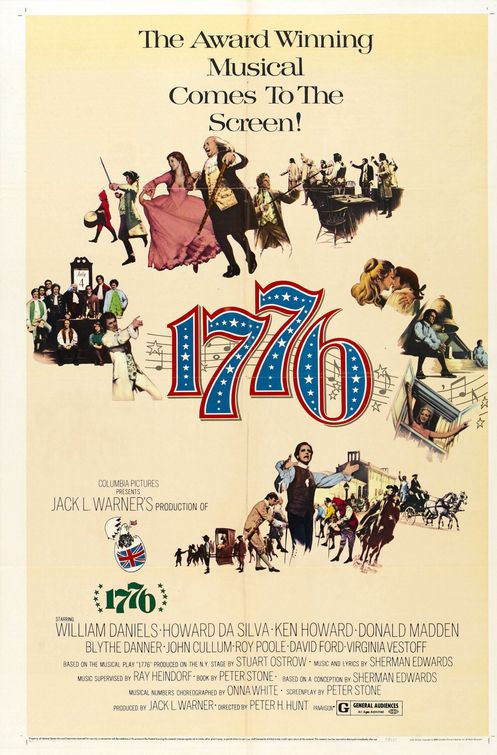
The Dietrich Theater will be having special showings of the 1972 film “1776” in celebration of America’s 250th anniversary. To commemorate the country’s anniversary, I have put together a special slate for July that will consist of films that involved either wars or special events throughout US history and this is the unofficial start of the slate!
“1776” is a historical musical drama that’s an adaptation of the Tony Award-winning 1969 Broadway musical. It premiered on Broadway on March 16, 1969, playing at theaters like the 46th Street Theatre before closing in 1972 after 1,217 performances.
The nation’s fathers harmonize their way through the founding of America in this musical adapted from a popular Broadway show. Colonial representatives gather in Philadelphia with the aim of establishing a seat of governmental rules for the burgeoning United States.
Benjamin Franklin and John Adams charged Thomas Jefferson with the work of writing a statement announcing the new country’s emancipation from British rule.
The 1972 film adaptation of the Broadway musical received heavily divided reactions upon release. While major critics stated that it was overly theatrical and somewhat corny, general audiences largely embraced its earnestness, witty banter, and surprising historical nuance regarding the birth of the nation. And, after streaming it on Tubi, “1776” is definitely a recommended watch for America’s 250th anniversary!
The musical film adaptation delivers a clever blend of catchy musical numbers, sharp political wit, and surprisingly grounded reality. It uniquely portrays the Founding Fathers not as perfect people, but as deeply flawed, relatable men dealing with intense ideological debates.
“1776” does a great job humanizing the Founding Fathers with their moments of comedic banter. The film’s portrayal of Benjamin Franklin (Howard Da Silva) provides a perfect comic counterbalance to John Adams’ (William Daniels a.k.a. Mr. Feeney for the 90s audience) rigidity. Franklin’s nonchalant, sarcastic attitude and his habit of quoting himself is easily one of the film’s highlights. There’s also some humorous running jokes regarding Jefferson’s severe writer’s block that can be hilarious.
I really enjoyed how the film balances its witty, political comedy with sudden moments of profound emotional weight. One of the most emotional moments is the “Momma Look Sharp” sequence where a young military courier returning from the front lines sings this somber elegy that brought the realities and horrors of war into a largely light-hearted film that is quite poignant.

There’s also the fairly emotional, yet sobering finale. Instead of a triumphant, patriotic musical finish, it closes with the somber ringing of a bell, with each toll acting as a premonition of sorts of the grave fates awaiting the signers of the Declaration. I really enjoyed how this ended and appreciated the quiet, haunting acknowledgment of the sacrifices that made American independence possible.
“1776” also dives into the world of politics of course, especially when the narrative takes a turn during the debate over slavery, which culminates in the powerful song “Molasses to Rum.” By exposing the North’s hypocrisy in financing the slave trade, the scene forces a devastating compromise where the anti-slavery clause is struck from the Declaration to secure Southern votes. This moment gives a raw glimpse at how systemic political compromises shape national destiny.
The adaptation is highly regarded as a unique, witty, and surprisingly grounded blend of musical comedy and historical drama. Though it initially faced mixed reviews, it has since achieved enduring cult classic status as an annual viewing tradition.
Historians and critics acknowledge that the film takes dramatic liberties - inventing scenes, altering timelines slightly, etc. However, it’s praised for capturing the ideological tension, regional divisions, and sheer dysfunction of the Continental Congress accurately in spirit.
MPA: Rated G (runtime 141 minutes)
Initial release date: November 17, 1972
Streaming: YouTube/Tubi/various PVOD services (as of writing this review)
In an interview in TV Guide in the 1970's, Ken Howard related that he was rehearsing some of his lines from the play aloud while traveling on an airplane. The inflammatory revolutionary rhetoric caused the plane's crew to summon the police and he was questioned by the authorities when the plane landed.
All of the exchanges between John Adams and Abigail Adams are based on the real letters they wrote to each other while John was away. He called her his "dearest friend" and their letters ended with "Til then".
While it is a running gag of the film that John Adams is considered "obnoxious" and is "disliked" by the other members of the Continental Congress, in David McCullough's Pulitzer Prize winning biography "John Adams" McCullough said he had examined the written recollections of all the members of the Congress and none of them had anything but praise for Adams--except for John Adams himself.
According to the writer/director's commentary, John Adams' actual quote following Benjamin Franklin's urging to remove the slavery clause from the declaration was, "If we give in on this issue, there WILL be trouble 100 years hence." The first battle of the Civil War occurred 85 years later, in 1861. The commentary stated that the quote was left out because it sounded too much like hindsight.
While it is generally accepted that John Hancock was the only one who signed the Declaration of Independence on July 4th, Sherman Edwards and Peter Stone chose to have the congressional delegates sign the document on that date in the musical for dramatic effect.
The tally board in the Congressional chamber, clarifying each colony's position at any given moment, didn't exist in real life. It's a dramatic device to help the audience follow the plot.
The final shot required the camera to pull back to show the entire Congressional chamber. However, there was not enough room on the set for the camera truck to pull back far enough. Since the sound stages being used were slated to be demolished after production ended, and this was the final shot being done, a large hole was made in the wall - with the camera truck protruding outdoors after pulling all the way back. As it turned out, the sound stages were never demolished and the wall was rebuilt.
The final scene shows the members of Congress being called individually to come forward in order to sign the Declaration of Independence while the camera trucks back, or zooms out. The characters' final positions are an approximation of John Trumbull's famous painting, The Declaration of Independence. The actual painting shows the congressional chamber from the front behind John Hancock's desk while the scene in the movie is from the rear of the chamber, and therefore the characters appear reversed with the five members of Congress who were assigned to the committee to write the Declaration on the right of the desk as opposed to the left. Far fewer of the actual number of delegates, who were in Congress, are represented in the movie, but the resemblance to the painting is unmistakable including the delegate sitting with one leg crossed over another.


Comments