


In Memory of Tim Curry: A Look at the 1980s Cult Classic “Clue”
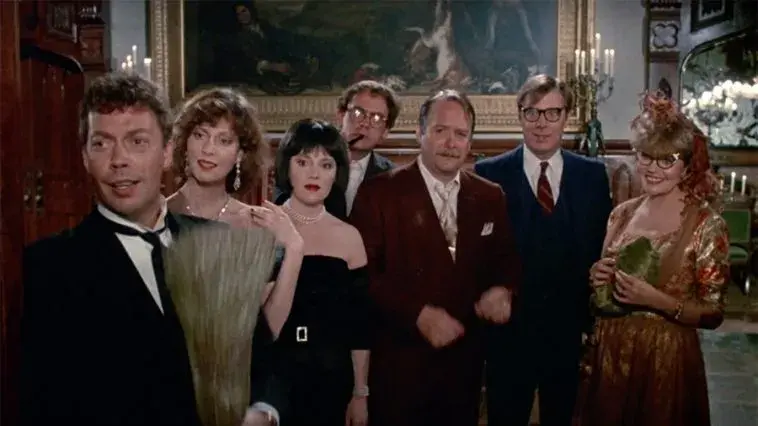
With the passing of acting legend Tim Curry a couple weeks ago (along with Dolly Parton), I took a look at his filmography to see what I can check out for this week’s review slate. Last Halloween, I checked out one of his most famous films ever, “The Rocky Horror Picture Show” and will likely check out the 1990 version of “It” in October. So, for this review, I decided to take a look at the 1985 movie “Clue” which became a cult classic after having a disappointing box office run.
Six blackmail victims are invited to an isolated mansion by a man who knows a dark secret from each of their pasts. On arrival, each is given a pseudonym before being introduced to the blackmailer.
Each is handed a weapon, at which point the lights are switched off and the blackmailer is killed. Can the guests uncover the murderer before they all become victims?
The audience response to the 1985 comedy-mystery movie “Clue” underwent one of the most dramatic shifts in cinema history, evolving from initial confusion and disappointment (due to the numerous endings and audiences not knowing which theater showed which ending) to a passionate, multi-generational cult classic adoration.
The 1985 classic features an incredible line up of actors and actresses, including Madelaine Khan, Martin Mull, Lesley Ann Warren, Michael McKean, Christopher Lloyd, and of course, the late Tim Curry (in a truly memorable performance). Every actor in the movie commits fully to high-energy, eccentric character tropes without ever competing for the spotlight.
As Wadsworth the butler, Tim Curry really acts as the chaotic engine of the movie, His frantic, rapid-fire monologue during the third act - where he recaps the entire plot by running through the entire mansion and physically re-enacting every murder - is now only the movie’s most stand-out and hilarious moment, but also my favorite sequence.
Besides the frantic third act where Curry brilliantly steals the show, there are quite a few other memorable and iconic moments that viewers and fans will really enjoy. One of the most memorable moments is when Mrs. White confesses to her deep-seated hatred for Yvete the maid, and she delivers her unforgettable, unhinged “flames, flames on the side of my face” speech.
From what I’ve read online, this moment was completely ad-libbed and that makes this scene even better. There’s also a tense stand-off in the foyer where Wadsworth tries to prove that the villain’s gun is empty by meticulously calculating how many shots were fired. And the fast-talking back and forth results in an absurdly chaotic and hilarious math argument.
The film’s director Jonathan Lynn (who also directed the comedy “My Cousin Vinny” - which I highly recommend), modeled the pacing on classic 1930s and 1940s farces. A good amount of the dialogue overlaps intentionally, with many characters finishing each other’s sentences, misinterpreting statements or dropping lightning fast retorts (“To make a long story short - “/”Too late!”).
The overall audience response to the 1985 movie “Clue” underwent a complete 180-degree turnaround, transforming from an unambiguous box office flop into a beloved, post-modern cult classic. When the movie was in theaters, it featured an unusual marketing gimmick where different theaters received different endings. Instead of enticing viewers to watch it multiple times, this gimmick confused movie-goers who didn’t know which theater showed which ending and many felt it was a cash grab tactic.
Once “Clue” was released on home video, TV and eventually streaming, the three endings were stitched together to play back to back. This structural change entirely fixed the pacing. Modern audiences widely celebrate the movie’s pacing, physical slapstick and verbal wit.
MPA: Rated PG (running time 94 minutes)
Initial release date: December 13, 1985
Streaming services: Paramount Plus/Pluto TV/MGM+/various PVOD services (as of working on this review)
Madeline Kahn's short "Flames...on the side of my face" monologue about her hatred for Yvette the French maid was ad-libbed.
Tim Curry has cited this as one of his favorite movies of his own.
In an example of attention to detail, the secret passages in this movie lead to the same rooms they do in the board game: the kitchen leads to the study and the conservatory leads to the lounge.
Lesley Ann Warren, Christopher Lloyd, and Martin Mull reunited to spoof the movie in the Psych episode 100 Clues.
Though this movie's performance at the box office was disappointing, it has since developed a cult following.
Professor Plum indicates at dinner that he works for the World Health Organization, part of the United Nations Organization. This means he works for UNO WHO.
It was John Landis's idea to have three different endings playing in different theaters. His reasoning was that if the audience caught on to this gimmick, they would each go to see the film three times. His plan backfired as people decided that they didn't want to pay three times to see the same film.
When Wadsworth cuts the power to the house during his solving of the mystery, it represents the point of divergence of the three endings.
The first movie based on a board game. The board game "Cluedo," was originally published by Waddingtons in the United Kingdom in 1949 followed soon after by the American version. It quickly became one of the world's most popular board games, eventually selling more than 100 million units and earning in excess of $1 billion.
John Cleese was considered for the role of Wadsworth.


Comments