


In Remembrance of Rob Reiner: “Misery” (1990)
- Matt Palmer
- Jan 9
- 5 min read

With the tragic passing of filmmaker Rob Reiner and his wife, I wanted to take a look at one of his most acclaimed films he has directed. I plan on checking out at least one or two more of these films coming up. For this review, I took a look at the 1990 film “Misery,” the Stephen King adaptation that ended up being Kathy Bates’ big break into Hollywood.
After a serious car crash, novelist Paul Sheldon is rescued by former nurse Annie Wilkes, who claims to be his biggest fan. Annie brings him to her remote cabin to recover, where her obsession takes a dark turn when she discovers Sheldon is killing off her favorite character from his novels.
As Sheldon devises plans for escape, Annie grows increasingly controlling, even violent, as she forces the author to shape his writing to suit her twisted fantasies.
“Misery” is one of the many Stephen King film adaptations I have seen numerous times over the years and each viewing of the film is just as tense as the last viewing. The 1990 film adaptation delivers a real good amount of tense moments, a lot of suspense-building sequences and a career-defining performance by Kathy Bates. And, honestly, if it wasn't for her incredible and slightly unhinged portrayal of the iconic Annie Wilkes, “Misery” probably wouldn’t be as remembered as it is.
Her portrayal of Annie Wilkes is highly unpredictable (for those who haven’t seen the film) yet she can also have a tiny bit of charm, creating one of cinema’s most iconic villains. Throughout her unforgettable performance, Bates does an incredible job shifting her portrayal between sweetness and brutality. And that’s what makes Annie Wilkes a compelling villain - especially since having the ability to switch from a caring nurse to a violent captor is no small feat.
Director Rob Reiner also did a great job delivering a Hitchcock-esque thriller with truly effective suspense. The film masterfully builds tension through its claustrophobic
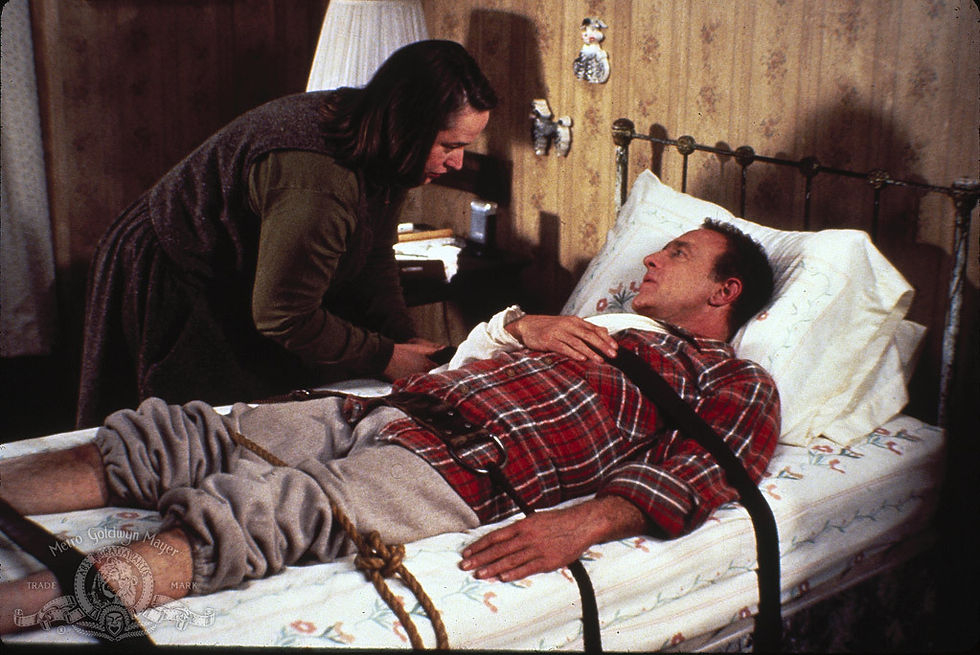
setting and the constant threat of Annie’s violent outbursts, which can make the film a nerve-wracking viewing experience.
While the final fight between Annie Wilkes and Paul Sheldon can be really nail-biting and tense, the most famous and traumatic moment occurs during the infamous “hobbling” scene and even after typing this sentence makes my ankles hurt (if you have seen the film and this scene, you know).
“Misery” is a masterclass in suspenseful, character-driven horror, praised for its adaptation of Stephen King’s novel, anchored by Bates’ iconic portrayal of the very unhinged Annie Wilkes and James Caan’s compelling performance as captive author Paul Sheldon. The film also effectively explores themes of fandom, control and trauma through its chilling psychological warfare and iconic brutal moments.
The 1990 film has also garnered significant accolades, primarily for Kathy Bates’ performance, which earned her both a Best Actress Oscar and Golden Globe win. The film was also recognized by the AFI (American Film Institute) for featuring one of cinema’s most iconic villains (ranked Annie Wilkes as the N0. 17 most iconic villain out of 100).
TRIVIA: Jack Nicholson was offered the role of Sheldon, but passed because he wasn’t sure he wanted to do another movie based on one of King’s novels, after what he had experienced with Kubrick in “The Shining.” Annie Wilkes was King’s favorite written character, because she was always surprising to write, with unexpected depth and sympathy.
MPA: Rated R (runtime 107 minutes)
You can currently stream “Misery” on the HBO Max streaming service.
Stephen King was quite impressed with Kathy Bates' performance in this film, so much so that he later wrote two more roles for her. The title role in his novel "Dolores Claiborne" was written with Bates in mind, and Bates later starred in the film adaption of Dolores Claiborne (1995). King also wrote the script for the TV mini-series The Stand (1994). His original novel featured a (male) character named Ray Flowers; upon hearing that Bates wanted to be involved in the miniseries, King re-wrote the part as a woman (Rae Flowers) just so Bates could play the part (uncredited).
James Caan once showed up to the set hungover, and all of the scenes he shot that day were unusable. Rob Reiner told Caan he had to do the scenes again because there was "a problem at the lab." When Caan learned it had nothing to do with labs, he offered to cover the money he lost the studio.
Jack Nicholson was offered the role of Paul Sheldon, but passed because he was not sure he wanted to do another movie based on one of Stephen King's novels, after what he had experienced with Stanley Kubrick on The Shining (1980).
James Caan and Kathy Bates clashed over their acting methods. Caan believed in as little rehearsal as possible. Bates, with her theater background, was used to practicing a lot. When she commented to Rob Reiner that Caan was not attempting to relate or listen to her, Reiner told her to use that frustration toward her character.
James Caan had to stay in bed for fifteen weeks of shooting. Caan said he thought that Rob Reiner was playing a "sadistic" joke on him, knowing the actor would not enjoy not moving around for so long. Caan was not used to playing a reactionary character, and found it much tougher to play.
Stephen King was initially reluctant to sell the film rights to "Misery" because he was skeptical that a Hollywood studio would make a movie faithful to his vision. However, King was impressed with one adaptation of his works, Stand by Me (1986), and agreed to sell "Misery" under the proviso that Rob Reiner would either produce or direct the film.
Annie Wilkes was Stephen King's favorite written character, because she was always surprising to write, with unexpected depth and sympathy.
Despite not getting along at first during the shoot after filming wrapped James Caan and Kathy Bates actually became good friends in real life. Bates was heartbroken upon hearing of Caan's passing in 2022 and said working with him in this movie was one of the best experiences in her career.
Buster, the sheriff played by Richard Farnsworth, does not appear in the novel; rather he's created as a sort of amalgam of different officers that visit the Wilkes home in the novel. In the film, they wanted to make Buster "more proactive", and to that end they gave him more deductive skills and drive towards finding Sheldon.
Annie Wilkes was ranked the seventeenth most iconic villain in the American Film Institutes list of "100 Heroes and Villains."
In 1991, Kathy Bates became the first woman to win an Oscar for Best Actress in a horror or thriller film. The first performer to win an Oscar for a horror film was Fredric March for his performance as the title character in Dr. Jekyll and Mr. Hyde (1931). The only other winners for acting in a horror film were Ruth Gordon for her performance as Mia Farrow's new neighbor with a hidden agenda in Rosemary's Baby (1968) (Best Actress in a Supporting Role), Anthony Hopkins and Jodie Foster for Best Actor and Best Actress in The Silence of the Lambs (1991), and Natalie Portman for Best Actress in Black Swan (2010).
Annie was always intended in the novel to be an amalgam of Stephen King's scariest fans.


Comments