


Rewind Back to 1996: A Look Back at “Mars Attacks” (30th anniversary)
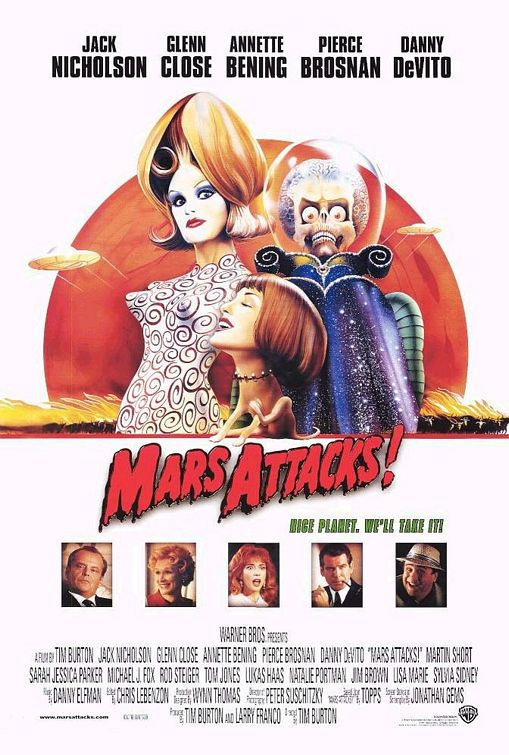
The Tim Burton-directed movie “Mars Attacks” was released theatrically on December 13, 1996 to very mixed reviews from critics, with praise for its comedic satire of 1950s sci-fi B movies, but criticisms for its dark humor. The movie grossed approximately $101 million in total box office, which was seen as a box office flop (due to its $80 to 100 million budget).
A fleet of Martian spacecraft surrounds the world’s major cities and all of humanity waits to see if the extraterrestrial visitors have, as they claim, “come in peace.” US President James Dale receives assurance from science professor Donald Kessler that the Martian’s mission is a friendly one.
But when a peaceful exchange with Congress ends badly, military men call for a full-scale nuclear retaliation.
I remember first watching this 1996 Tim Burton movie many years ago. I thought it was a very entertaining movie - campy and cheesy, but entertaining. After revisiting it for the first time in years, even though there are definitely some dumb moments, “Mars Attacks” is still campy entertainment.
When the movie hit theaters nearly three decades ago, the initial reaction was largely mixed and slightly confused. Expecting a glossy, heroic blockbuster (like “Independence Day” which was released months before this movie), audiences and critics instead encountered a mean-spirited, highly cynical homage to 1950s B movies and the infamous 1962 Topps trading card set.
The main thing that really stands out with this cult classic is the dark humor and the lack of sentimentality that the movie has. In fact, the movie is almost like a masterclass in cynical, dark humor.
The movie treats the annihilation of humanity as a giant, yet chaotic cartoon joke at times. Rather than focusing on heroic survival, the movie also thrives on the cruelty of its big-brained alien invaders and the profound incompetence of Earth’s leaders (which is actually pretty hilarious).
There are many moments of dark humor in the movie that highlights its twisted comedy, such as the Martians wiping out an entire welcoming committee while a universal translator repeatedly announces “We come in peace,” and the disastrous Congressional greeting where the Martians act like they’re being peaceful yet again before zapping them with their ray guns, turning them into red and green neon-colored skeletons.
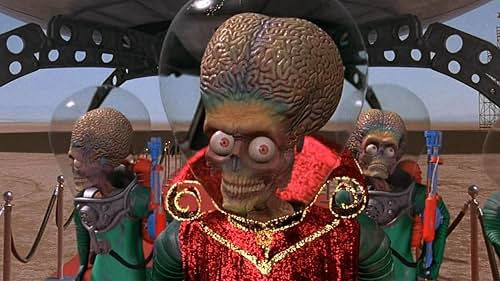
“Mars Attacks” also has a massive cast of superstar actors - Jack Nicholson, Glenn Close, Michael J. Fox, Pierce Bronson, a small part from a young Jack Black, among many others - and pretty much the whole ensemble cast gets absurdly wiped out. And instead of a high-tech virus or military strategy saving Earth like most alien movies, the absurdity of Slim Whitman’s yodeling country song “Indian Love Call” literally exploding the aliens’ brains remains one of the most ridiculous, yet humorous ways to wrap up an alien invasion movie.
Most audiences never really noticed at the time that the movie was 100% intentionally cheesy as Burton set out to make an affectionate big-budget homage to low-budget 1950s sci-fi movies (like "Plan 9 from Outer Space” and “Earth vs. the Flying Saucers”). Burton even had the visual effects team animate the Martians with jerky, unnatural movements that look like stop-motion puppets.
The overall response to Tim Burton’s 1996 sci-fi/comedy “Mars Attacks” has evolved significantly from mixed reviews and box office disappointment upon its initial release to achieving a prominent cult classic status today. In the decades since its release, it has undergone a massive reappraisal. With modern audiences frequently comparing its chaotic rhythm to classic WB animations and its cynical mockery of political incompetence, news radio narcissism and military bluster is now viewed as an incredibly sharp and prescient time capsule of pre-9/11 dark comedy.
MPA: Rated PG-13 for sci-fi fantasy violence and brief sexuality (runtime 106 minutes)
Initial release date: December 13, 1996
Streaming: Tubi/Pluto TV/The Roku Channel/various PVOD services (as of working on this review)
To make the Martian Girl costume as smooth as possible, it had no zippers or buttons on it. Lisa Marie had to be sewn into it every day before filming of her scenes in it could even begin.
Jack Nicholson accepted his role in the film without reading its script, since he had enjoyed working with Tim Burton on the film Batman (1989) and wanted to work with him again.
The film's writers were not sure what the Martians should sound like, so its script used "Ack! Ack! Ack! Ack! Ack! Ack!" for all of their lines of dialogue. This became their actual language in all future "Mars Attacks" merchandise and media.
When humans were disintegrated by the Martians' ray guns, the resulting skeletons were colored either red or green Tim Burton explained this had been done because the film had been scheduled for a Christmas release. Also, the red and green skeletons were first seen in the film Beetlejuice (1988) when Barbara and Adam were in Juno's office, you can see them with other ghouls looking at the screen.
While the film was set in the 1990s, the U.S. Army's uniforms and equipment date from the 1950s when the films being parodied in it were made.
Tim Burton had wanted to bring the Martians to life in the film via stop-motion animation as an homage to the films of special effects legend Ray Harryhausen. He first considered Henry Selick as the right man for the job, but Selick was busy with his own stop-motion film James and the Giant Peach (1996). They initially worked with a different team of animators, but when the studio refused to finance the projected costs, they finally decided on computer-generated images created by Industrial Light & Magic, which was much cheaper. The ILM animators made the CGI purposely look a bit cheap and fake as per Burton's request, although he decided against animating the Martians without motion blur, which would have made them look more "stop-motiony".
Michael J. Fox had been suffering from symptoms of Parkinson's disease of slowly but steadily increasing severity for several years by the time filming was underway. Notably, evidence of Fox's struggle with the disease are apparent during the scene of the Martians' first attack, where he can be seen experiencing moderate tremors in some shots. The filmmakers were able to integrate this into the film by having his character, Jason Stone, experience fear at the sight of the Martian invaders.
In the first drafts of the film's script and in its tie-in novelization, the Martians' ray guns had a great variety of lethal graphic effects. The ray guns' victims were bisected, body parts were cut off, and huge holes were blown right through them. Other victims were melted, shredded, or set on fire. To avoid an R rating from the MPAA, the producers toned down the effects of the Martian ray guns and their victims were merely disintegrated into skeletons.
Although Danny DeVito has billing above the title in most of the theatrical release posters, the DVD covers and other promotional artwork for the film, he plays an unnamed character with six lines and approximately 1.5 minutes of screen time.
When asked by Premiere magazine about the film's failure at the box office, Rod Steiger said that Warner Brothers, seeing the success of the film Independence Day (1996), another alien invasion film released that July, decided to move their film to December 1996 from its original 1997 release date. This caused great pressure on Tim Burton to deliver a faster cut and thus led to its box office failure, as Burton could not make the film the way he had intended to.


Comments