


Rewind Back to 2011: A Look at “Real Steel” (15th anniversary)

For this review for my ongoing Rewind Series, I wanted to take a look at a movie released in 2011 that did alright during its domestic theatrical run (yet made a lot of money internationally) and eventually becoming a modern cult classic. The subject of this review - the 2011 movie “Real Steel.”
Charlie Kenton used to be a prizefighter but lost his chance to win a title when heavy, towering robots took over the boxing ring. Now working as a small-time promoter, Charlie pieces together scrap metal into low-end fighters, barely earning enough to make it from one underground venue to the next.
After hitting rock bottom, Charlie reluctantly teams with his estranged son, Max, to build and train a championship robot for a last shot at redemption.
Audience reception for 2011’s “Real Steel” (celebrating its 15th anniversary) was significantly warmer and enthusiastic than critics, turning this sports/sci-fi movie into a crowd-pleasing viewing experience. While most critics viewed the overall plot as somewhat formulaic, moviegoers embraced its emotional core, action, and great visual effects.
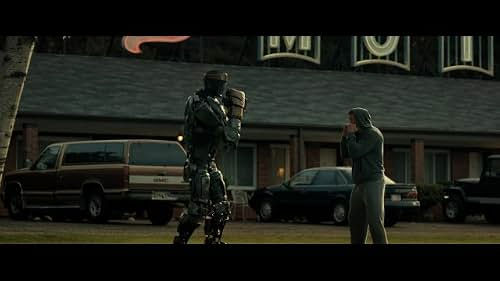
One of the things that really impressed me was that the production built actual life-sized animatronics for close-ups alongside the motion-capture CGI that’s used in the other scenes (which honestly looks fantastic). Even during the moments when the CGI robots are present, the robots look really incredible and, for the most part, look like they are actually there and not looking like weightless computer graphics.
The father-son dynamic between Charlie and Max is easily the emotional anchor of “Real Steel,” elevating it above standard action blockbusters. While Charlie starts out as a dead-beat dad who literally sells full custody of his son for money, his eventual story arc feels earned as he slowly confronts his own cowardice and regret.
Max’s eventual unyielding faith in both Atom (their robot) and his dad serves as the catalyst that pushes Charlie back into the boxing world. Their banter - ranging from
fiery arguments to even synchronized victory dances - gave the movie a level of warmth and humor that can easily resonate with anyone.
“Real Steel” also delivers plenty of crowd-pleasing moments that viewers will really enjoy. One of the best moments happens during the final fight when Atom’s vocal controls break against the champion and Charlie has to switch to the robot’s shadow mode - literally boxing/controlling the robot from the edge of the ring. Watching Charlie rediscover his passion for fighting while Max tearfully watching his father box creates the movie’s strongest emotional high.
There’s also a few other moments that are really entertaining, such as Charlie bringing his old, battered robot Ambush to a local fairground to fight a live bull and a fun sequence where Max teaches Atom a synchronized dance that they will perform before major fights.
While critics were highly divided, often pointing out the movie’s formulaic script, general audiences embraced it much more enthusiastically ($85 million domestic/$263 million worldwide). General moviegoers praised the “underdog” charm of the robot Atom, the high-energy fighting choreography and the emotional father-son redemption arc. Over the years, its popularity has surged on streaming platforms, solidifying its status as a nostalgic cult favorite of the 2010s.
MPA: Rated PG-13 for some violence, intense action and brief language (runtime 127 minutes)
Initial release date: October 2, 2011
Streaming: Tubi/various PVOD services (as of working on this review)
Each of the robots were built both in real life and CGI. For certain shots with animatronics, they were controlled by more than twenty puppeteers.
Much of the robot boxing fights were motion-captured using professional boxers, supervised by Sugar Ray Leonard.
When first sent the script, Hugh Jackman read it to his son Oscar as a bedtime story. Oscar was so captivated by the story of 'Real Steel' that Jackman knew he had to take the role of Charlie Kenton.
The film is based on "Steel," a 1956 short story by I Am Legend (2007) author Richard Matheson. It was previously adapted as the short teleplay Steel (1963).
Shawn Levy opted to have more practical effects and puppeteering of the robots at the behest of Steven Spielberg.
This was the final film adapted from a story by Richard Matheson before his death on June 23, 2013, at the age of 87.


Comments